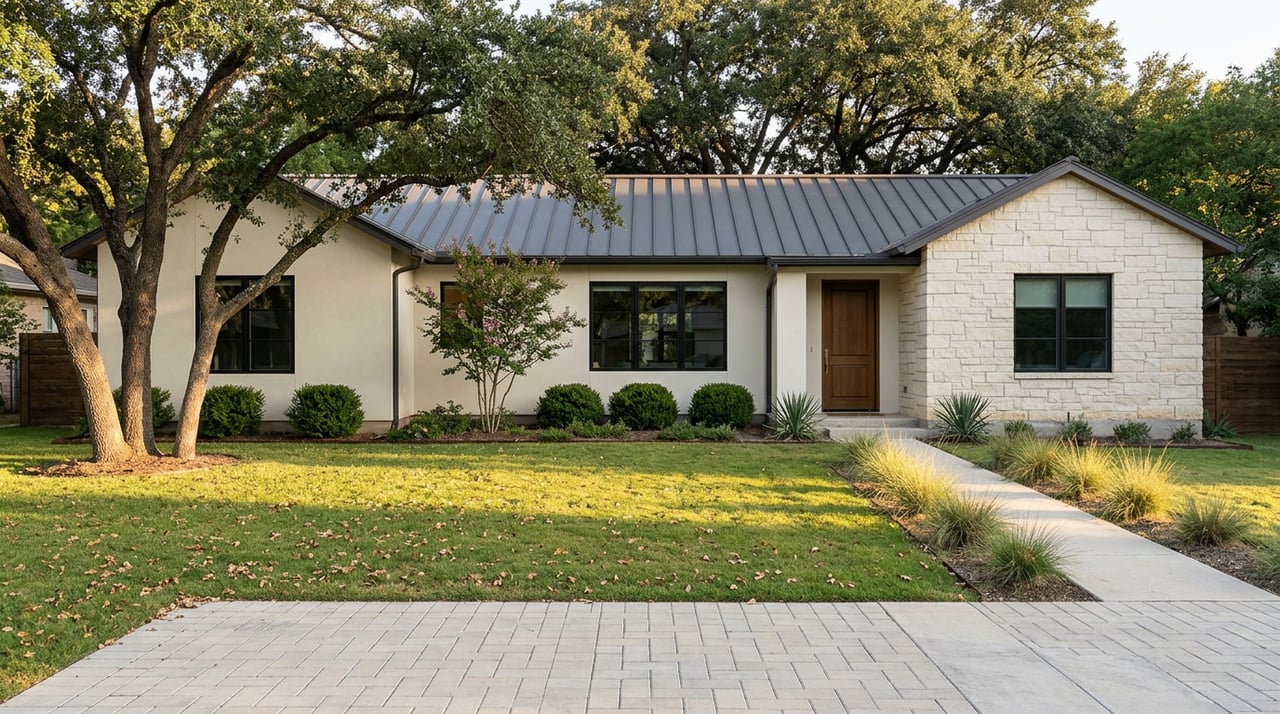
An investor finds an Austin house listed with a strong Airbnb track record. The seller shares screenshots of a full calendar and a valid city license number posted right on the listing. The math works. The buyer assumes the license transfers at closing the same way the water heater and the HVAC system do.
It does not. Under Austin's short-term rental ordinance, a license is issued to the operator, not the property, and it cannot be conveyed or transferred with a sale. The new owner starts from zero: a fresh application, a fresh review against the city's current caps, and no guarantee the address will qualify again the way it did for the seller.
That single fact reframes how an STR-minded buyer should shop in Austin right now. The city spent 2025 rewriting its rules in a way that made headlines sound like short-term rentals got easier here. In one narrow sense they did. In the sense that actually matters to a buyer writing an offer, they got harder to predict.
The Zoning Opened Up. The Licensing Math Did Not
In February 2025, Austin City Council passed a set of ordinances that made short-term rentals an accessory use in every residential zoning district in the city, reversing years of restrictions that had walled non-owner-occupied rentals out of most single-family neighborhoods. That same package moved STR regulation out of the land development code and into the city's business regulation title, treating a short-term rental less like a land use question and more like a licensed business, the same category as a restaurant or a daycare.
Then, in September 2025, the council followed up with Ordinance No. 20250911-012, which rewrote the operating rules. This second ordinance is the one that matters for anyone evaluating a specific address, because it introduced the caps that actually gate access to a license: no more than two STR units on a single-family site, a required 1,000 feet of separation between any two sites the same operator runs, and density caps of 10 percent of units in a purely residential multifamily building or the greater of one unit or 25 percent in a building with ground-floor commercial use. Most of these operator-facing rules took effect October 1, 2025.
Read the zoning story alone and Austin looks wide open. Read the licensing math and a specific address either clears the caps or it does not, and that answer can change as neighboring properties get licensed first.
What Actually Decides Whether an Address Can Get a License
| License type | Who it's for | Where it applies |
|---|---|---|
| Type 1 | Owner-occupied, primary residence | Allowed in all residential zoning districts, no cap on nights rented |
| Type 2 | Non-owner-occupied, whole home, single site | Capped at two units per single-family site; 1,000-foot spacing from the operator's other sites |
| Type 3 | Non-owner-occupied, multifamily or condo unit | Capped at 10 percent of units in residential buildings, or the greater of one unit or 25 percent in mixed-use buildings |
A new license currently runs $836.30, which includes a $789 license fee and a $47.30 notification fee the city uses to notify neighbors within 100 feet of the property at every renewal, not just when the license is first issued. Renewals cost $385.30. Licenses now run for two years instead of one, a change meant to reduce the paperwork burden, but the fee structure and the caps apply the same way at renewal as they do on a first application, and the city does not refund the fee if an application is denied.
For an investor comparing a licensed STR to a comparable long-term rental, the caps are the number that belongs in the spreadsheet next to the purchase price, because they determine whether the STR income line is even available to the buyer after closing.
The Gap Between Licensed and Actually Operating
Austin's own numbers show how much of the market has been running outside that licensing structure. The city reported 2,750 active STR licenses as of March 31, 2026, up nearly 20 percent from the year before. The city's own open dataset showed that climbing to 2,899 licenses by July 24, 2026, and 2,910 by September 8, 2026.
Set against that, city staff used listing-scraping software to identify 2,785 unlicensed addresses between January and April 2026 alone, a number close to the entire licensed inventory. That enforcement push produced 65 notices of violation, 28 citations, and 32 new license applications in that window, according to the city's own memo to Council. Hotel occupancy tax revenue tied to short-term rentals climbed from $7 million in fiscal year 2024 to $11.6 million in fiscal year 2025, with $10.6 million collected in the current fiscal year as of the spring 2026 memo, evidence that the license-and-tax structure is starting to catch operators who had been running under the radar.
Not every host welcomed the tighter accounting. One Austin STR operator, quoted by local outlet Austin Current in March 2026 after years of paying hotel occupancy taxes while competitors did not, described the mood among unlicensed hosts facing the new rules as "a frenzy of folks freaking out." For a buyer, that reaction cuts both ways. Some inventory is exiting the STR pool entirely, which can mean less competition for a compliant operator. It also means a listing's existing booking history may have been built on operations the new owner cannot legally replicate at the same address if the caps have since filled up.
July 1 Was Not the Cliff Most Coverage Made It Out to Be
A lot of 2026 STR guidance treated July 1 as a hard deadline: get licensed by then or lose your listing overnight. The actual rollout has been slower. Platform obligations under the ordinance, requiring Airbnb, Vrbo, and similar sites to display a license number on every Austin listing and remove unlicensed ones within 10 days of a city notice, were originally proposed to start in May 2026 and were pushed back two months to July 1 by Council. The city's new online licensing system did not launch until May 18, 2026, and staff told Council that mass delisting notices would be paused for roughly six months after that launch, then phased in starting with properties that have already generated nuisance complaints. The city also pauses enforcement action against an address while its license application is under review.
That distinction matters for timing an STR purchase this fall. An unlicensed listing is not necessarily days from disappearing. It is, however, sitting in a system that is actively identifying addresses like it and working through them in phases, which means the safe assumption for a buyer is that any STR-oriented purchase needs its own license application in motion well before closing, not a bet that enforcement will stay slow indefinitely.
Before You Write an Offer on an Austin STR
- Confirm the property's exact zoning and site type. Two adjacent-looking houses can fall under different rules depending on lot configuration and whether the building includes ground-floor commercial space.
- Ask the seller or their agent for the property's current license number and check its status and expiration directly with the city rather than relying on a screenshot of the listing.
- Find out if the seller, or anyone else, already operates a licensed STR within 1,000 feet. That distance requirement applies to the operator, but a densely licensed block signals the multifamily or mixed-use caps nearby may already be tight.
- For a condo or multifamily unit, ask the building's HOA or management company how many units in the building already hold STR licenses relative to the 10 percent or 25 percent cap.
- Budget for a new license application as a closing cost, not an assumption. At $836.30 with 6 to 10 weeks of processing time, it belongs in the timeline the same way an inspection period does.
FAQ
Does an Austin STR license transfer to a new owner at closing? No. Licenses are issued to the operator for a specific address and cannot be conveyed or transferred with a property sale. A new owner has to apply from scratch and clear the current caps and spacing rules, which may have changed since the seller was first licensed.
What happens to an unlicensed Austin STR listing right now? The city is not delisting every unlicensed property at once. Enforcement is being phased in, starting with addresses that have generated nuisance complaints, and the city pauses action against a property while its application is under review.
Do the per-site caps apply to the property or the current owner? The two-unit cap on single-family sites and the 1,000-foot spacing rule are tied to the operator, meaning a new owner's application is evaluated fresh against whoever else is currently licensed nearby, not against what the previous owner was allowed to run.
If you are weighing an Austin property for its short-term rental potential, or you already own one and want a clear read on where it stands under the current rules, The Niño Team can walk through the licensing math with you before you write an offer. Contact Us.